For twenty years, digital marketing operated under a single, non-negotiable law:
If you hold Position #1 on Google, you win the customer.
You paid the monthly retainer. You produced hundreds of blog posts. You monitored keyword rankings with obsessive precision. When your site finally captured the coveted top spot—or even better, Google's featured snippet at “Position Zero”—your pipeline was practically guaranteed.
Rank first, win the click, capture the phone call, bank the revenue.
That formula created billion-dollar empires and built tens of thousands of thriving service businesses.
And today, that formula is fundamentally breaking down.
Not because Google changed its algorithm again. Not because a competitor built more backlinks than you.
It is breaking down because modern buyers are no longer performing searches the way they did for the last two decades.
The Ghost in the Analytics Dashboard
Consider a scenario playing out in corporate boardrooms and service businesses every single week:
A managing partner at a boutique corporate law firm notices a bizarre anomaly. The firm’s quarterly SEO report is flawless:
- Primary commercial keyword: #1 Rank
- Secondary practice areas: Top 3 across the board
- Domain authority: High 60s
Yet over the last two quarters, inbound inquiries for seven-figure corporate litigation dropped by 41%.
When the managing partner pressed their marketing director, the answer was bewildered silence: "The analytics show our impressions and rankings are rock-solid. People just aren’t submitting forms."
The marketing director was looking at the right dashboard on the wrong battlefield.
The missing clients didn’t look at the website and decide not to call. They never reached the website in the first place.
When the CFO of a regional distributor needed a litigation team to handle an emergency breach-of-contract dispute, she didn’t open Google, scroll past four sponsored ads, dodge cookie banners, and read three law firm blogs.
She opened ChatGPT and asked:
"Who is the most experienced commercial litigation firm in Dallas with proven trial defense in supply chain logistics disputes, and what is their turnaround time for emergency injunctions?"
ChatGPT synthesized an answer in 1.8 seconds.
It didn’t provide ten links. It recommended a single firm across town, cited their recent verdict figures, quoted their emergency intake policy, and provided their managing partner’s direct office extension.
The client placed the call from the ChatGPT interface. A $250,000 retainer changed hands before the day was over.
The firm sitting at #1 on Google never even knew the opportunity existed.
Welcome to the "AI Intercept"
We call this phenomenon the AI Intercept.
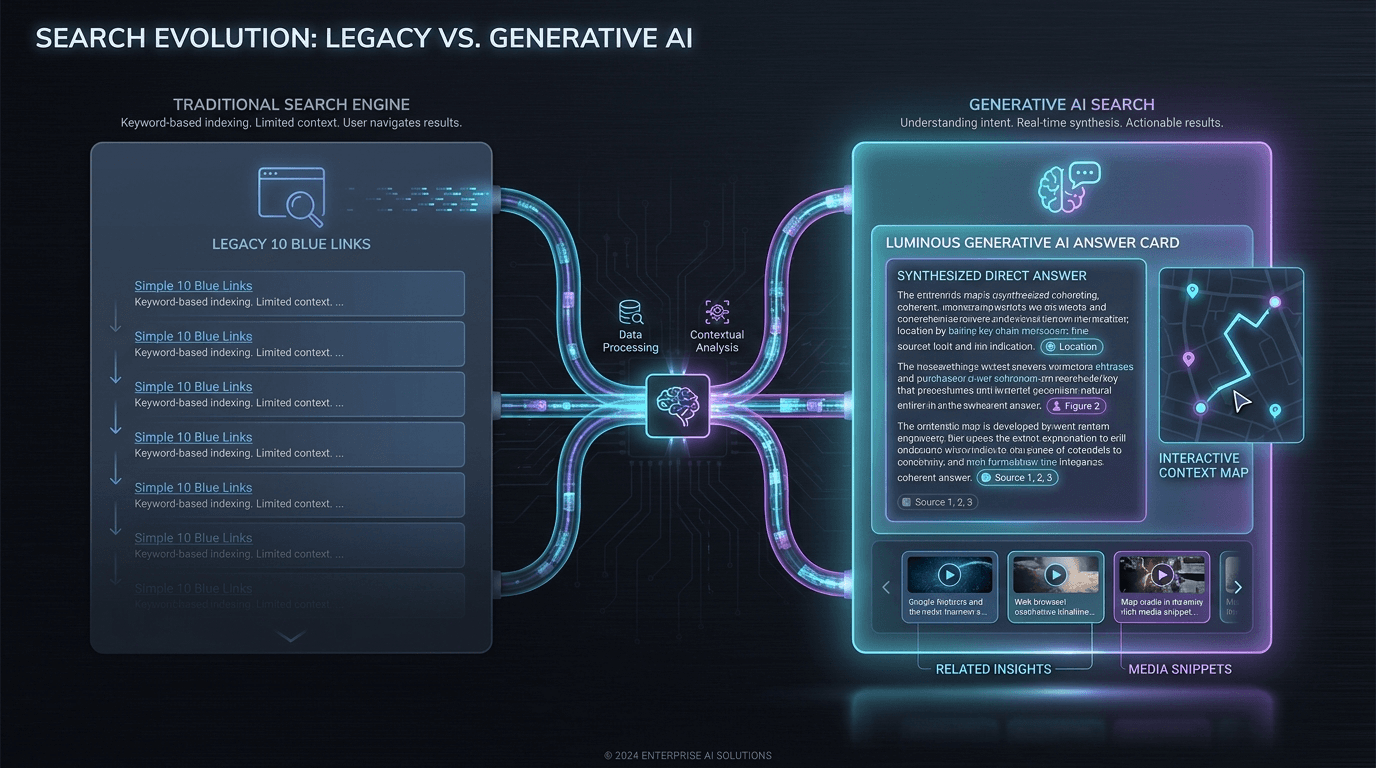
TRADITIONAL SEARCH (The Linear Funnel)
User Query ──► 10 Blue Links ──► Website Click ──► Site Exploration ──► Conversion
                   ▲
                   └── [Your #1 Ranking Won Here]

THE AI INTERCEPT (The Generative Compression)
User Query ──► Conversational Engine ──► Synthesized Recommendation ──► Direct Action
                   (ChatGPT / Perplexity / Gemini)     ▲
                                                       │
                           [Competitor Chosen Here ────┘
                            Your site was never visited]
In traditional search, consumers were forced to do the heavy lifting:
- Type a truncated keyword (
commercial litigation dallas tx). - Sift through 3–4 sponsored Google Ads.
- Open 4 separate tabs in their browser.
- Scan each homepage to evaluate credibility, experience, and pricing.
- Choose one to contact.
Under that model, Position #1 had massive value because user attention is scarce and human beings rarely click past the top three organic results.
Conversational AI flips this paradigm on its head.
Engines like ChatGPT Search, Perplexity Pro, and Google AI Overviews do not serve as an index of destinations; they act as an autonomous research assistant.
The user delegates the entire evaluation phase to the model:
- “Filter out the fluff.”
- “Compare their verified capabilities.”
- “Give me the single best option with proof.”
When the model answers, the funnel collapses from a 5-step browsing session into an immediate decision.
Position #1 on Google is worthless if the searcher never opens Google.
Why Position Zero Cannot Survive Conversational AI
In SEO, "Position Zero" was the holy grail—the featured snippet box Google placed at the very top of search results. It answered the user’s question directly, often pulling a paragraph from your site.
Many warned that Position Zero was leading to "Zero-Click Searches" (where users got their answer and left without clicking). But even then, your brand name was prominently displayed, and 50%+ of users clicked through for deeper context.
The AI Intercept goes infinitely further than Zero-Click Search:
| Dimension | Google Position Zero (Featured Snippet) | The AI Intercept (Conversational Synthesis) |
|---|---|---|
| User Output | A lifted quote snippet + source link | A synthesized, authoritative recommendation |
| Evaluation | Human reads your snippet and decides | Model evaluates candidate sites and decides for the user |
| Competitor Presence | One company featured, 10 links below | 1-2 winners cited; everyone else completely invisible |
| Measurement | Trackable in Google Search Console | Invisible in traditional web analytics |
| Trust Vector | User trusts their own evaluation of your site | User trusts the neutral synthesis of the AI assistant |
When an AI engine synthesizes a response, it doesn't just present information—it presents an endorsement.
If the model doesn't cite your business, you don't drop to position #2. You do not exist.
Why Traditional SEO Agencies Miss the Threat
Why aren’t marketing agencies shouting this from the rooftops?
Because their measurement tools are blind to it.
- Google Search Console tracks impressions on Google Search. It cannot tell you how many potential clients asked Perplexity or ChatGPT about your services today.
- Google Analytics records sessions and pageviews. It has zero visibility into the users who bypassed the web entirely.
- Keyword Rank Trackers ping traditional search results from automated servers. They send you green weekly reports celebrating your #1 ranking on terms that humans are typing into search bars less and less every month.
This creates a dangerous illusion of safety: rankings stay high while client acquisition drops.
By the time the revenue drop becomes undeniable, competitors who optimized for AI retrieval months earlier have already cemented their authority in the model's neural retrieval index.
How to Protect Your Brand from the AI Intercept: The 3 Gates
If ranking #1 on Google isn't enough, what does it actually take to win the AI Intercept?
Generative search engines don't rank websites based on PageRank or keyword density. They evaluate candidate websites through three deterministic gates:
 ┌────────────────────────────────────────────────────────────────────────┐
 │                    THE 3 GATES OF THE AI INTERCEPT                     │
 └───────────────────────────────────┬────────────────────────────────────┘
                                     │
           ┌─────────────────────────┼─────────────────────────┐
           ▼                         ▼                         ▼
 ┌───────────────────┐     ┌───────────────────┐     ┌───────────────────┐
 │   GATE 1: ACCESS  │     │   GATE 2: INDEX   │     │    GATE 3: CITE   │
 ├───────────────────┤     ├───────────────────┤     ├───────────────────┤
 │ AI Crawler Can    │     │ Entity Graph &    │     │ Concrete Facts &  │
 │ Reach Static HTML │     │ Directory Consens.│     │ Quantitative Proof│
 └───────────────────┘     └───────────────────┘     └───────────────────┘
1. Gate 1: ACCESS (Infrastructure & Crawlability)
Before an AI model can recommend your firm, its retrieval spiders (OAI-SearchBot, PerplexityBot, ClaudeBot) must be able to fetch your site in under 2,000 milliseconds.
- If your Web Application Firewall (Cloudflare, AWS WAF) returns a
403 Forbiddenor a CAPTCHA challenge to search bots, the engine drops you instantly. - If your website relies entirely on client-side JavaScript hydration (Single Page Apps) without server-side rendered HTML, the crawler reads an empty screen.
2. Gate 2: INDEX (Entity Clarity & Schema Consensus)
AI models are terrified of hallucinating incorrect phone numbers, disconnected addresses, or out-of-date pricing.
- To protect itself, the model cross-references your website against an external entity web: Google Business Profile, Apple Maps, Bing Places, and state licensing registries.
- If your Name, Address, and Phone (NAP) details conflict, or if your site lacks structured Schema.org JSON-LD markup, the AI discounts your reliability and defaults to a competitor whose data is unambiguous.
3. Gate 3: CITE (Proposition Density & Quantitative Data)
When the AI finally evaluates your content to decide who to quote, it looks for verifiable facts, not marketing adjectives.
- Academic research from Princeton University (ACM SIGKDD 2024) demonstrated that adding verifiable quantitative statistics, turnaround times, and pricing baselines increased AI attribution probability by +37.2%.
- Fluffy marketing copy ("We provide world-class excellence and unmatched dedication") is discarded as low-signal noise.
- Specific, verifiable copy ("Emergency dispatch within 45 minutes; over 1,200 commercial facilities serviced since 2018") is lifted directly into the AI's final synthesized recommendation.
The Verdict: Don't Defend a Graveyard
Being #1 on Google was the crowning achievement of the web's first two decades.
But consumer behavior has crossed the chasm. The highest-paying, most decisive clients in your industry are asking AI models to make buying recommendations for them right now.
You can continue celebrating a #1 ranking on a search page that fewer people are looking at every day.
Or you can audit your site for the new rules of generative discovery—and make sure that when an AI engine is asked who to hire, your company is the only answer it gives.
Is Your Website Ready for the AI Intercept?
Most website owners have no idea whether AI search bots are being blocked by their firewall, whether their entity graph is broken, or whether their content passes Gate 3.
Scrutor is the deterministic GEO audit engine built to answer those questions in 30 seconds.
👉 Run a Free 3-Gate AI Diagnostic on Your Domain at Scrutor.co →